Slow Philosophy
#notesinprogress
#thinkinginmotion
One of my complaints about academia is the constraints of time. I get a two-week module to explore ideas like free will and that is not how I want to do philosophy.
I want to wander slowly through a forest of ideas and see what seeds I can collect to test in my own garden.
This note came from a phrase I wrote in another note. I linked it, clicked the link, created a new note, and then started to ponder.
I start with gathering some sources. I still do Google searches, but more and more, I start a new NotebookLM project, find sources, and use the AI tool to give me an overview of the sources to see which ones I want to prioritize in my explorations. NotebookLM is owned by Google, so it's sourcing is basically an AI-powered Google search, but you can ask it questions and get answers specific to what's in the sources.
For this, I did start with a Google search.
The first result was a book called Slow Philosophy on Amazon. The Kindle version is $29.65. I'm on a budget. I turn to the university library website. Score! I have access with my student login!
Citations
APA
Walker, M.B. (2017). Introduction: On Being Slow and Doing Philosophy. In Slow Philosophy: Reading against the Institution (pp. 1–34). London: Bloomsbury Academic. Retrieved July 20, 2025, from http://dx.doi.org/10.5040/9781474279949.0006
MLA
Walker, Michelle Boulous. "Introduction: On Being Slow and Doing Philosophy." Slow Philosophy: Reading against the Institution. London: Bloomsbury Academic, 2017. 1–34. Bloomsbury Collections. Web. 20 Jul. 2025. http://dx.doi.org/10.5040/9781474279949.0006.
Chicago
Walker, Michelle Boulous. "Introduction: On Being Slow and Doing Philosophy." In Slow Philosophy: Reading against the Institution, 1–34. London: Bloomsbury Academic, 2017. Accessed July 20, 2025. http://dx.doi.org/10.5040/9781474279949.0006.
After that on the Google search are a bunch of articles, so I hop over to NotebookLM, start that new project, and have it discover sources for me - most of the same sources were in the Google search I did, as expected.
But now, I can generate an AI-simulated conversation in the form of an audio podcast that synthesizes all the sources.
https://notebooklm.google.com/notebook/e63f1de8-3272-4d99-b319-6062e1a2e15e
I'm not exploring academically - I track my sources so I can come back to them not so I don't get knocked points off on a paper. Though they may end up coming in handy in later academic encounters. Time will tell.
My biggest complaint about academic philosophy is that you only get to spend a short time on various concepts. There's only so many deep dives into a topic you can do at this level. And that's fine when you're studying philosophy in your early 20s and running on adrenaline to finish a paper doesn't require three days of recovery as you tried to wrangle all the tangents the readings sent you on that would get points knocked off for being too scattered in a paper.
I want to take my time exploring webs of ideas, sometimes coming back again and again to the same clusters of ideas, and sometimes venturing out to find or create new ones.
Without having to produce grade-worthy papers about it. My mind meanders across disciplines and I don't want to be constrained by hierarchy.
So I'm exploring how to translate that to a content pivot - how to build an audience around slow explorations of philosophy, old and new, and the tangents those explorations spawn.
NotebookLM Source Bibliography
#NotebookLM generated content w/links added by the human
Here is a bibliography of the provided sources:
- Joppich, Stephan. "Deep Reading: The Forgotten Skill to Absorb Everything You Read." Stephan Joppich Blog, July 18, 2022.
- https://stephanjoppich.com/deep-reading/
- Status: Read
- Thoughts: Nice intro to the idea of deep reading. Very reminiscent of Lectio Divina practices to go deeper with a text, and how I already apply that the texts, whether they're academic, fictional, or essays.
- Things to test: Creating a distraction-free reading practice to go more deeply into reading. Start with 30 minutes.
- Komjathy, Louis. "Philosophizing Contemplation: Towards a (Re)new(ed) Contemplative Philosophy." Blog of the APA - American Philosophical Association, May 26, 2022.
- Menon, Bindu. "Slowing down: Why a more contemplative and simpler approach to #life is being adopted as a personal philosophy." The Tribune, November 3, 2024.
- Reddit. "How would you design a self-directed study of philosophy? : r/askphilosophy." Reddit, (Archived post with various user comments).
- Reddit. "Is academia necessary to produce useful philosophy? : r/askphilosophy." Reddit, (Archived post with various user comments).
- Salo, Petri & Heikkinen, Hannu L.T. "Slow Science: Research and Teaching for Sustainable Praxis." Confero: Essays on Education, Philosophy and Politics 6, no. 1 (2018): 87–111. (Note: This source includes references to other works such as The Slow Professor: Challenging the Culture of Speed in the Academy by Maggie Berg and Barbara K. Seeber, and In Praise of Slow. How a Worldwide Movement is Challenging the Cult of Speed by Carl Honoré, among others).
- The Information Philosopher. "The History of the Free Will Problem." (Chapter 7).
- The University of North Carolina at Charlotte, Department of Philosophy. "Information on Non-Academic Careers for Philosophers." (Website content).
- Unattributed (by John Doe). "Leisure is the Mother of Philosophy." HybridMag, January 14, 2025.
- Faulkner, Joanne. "Slow Reading and Philosophy's Futures: Michelle Boulous Walker, Slow Philosophy: Reading Against the Institution (Bloomsbury, 2017)." Parrhesia journal 28 (2017): 225-237. (Note: This is a review of Michelle Boulous Walker's book and heavily discusses its themes and arguments, citing the book throughout).
Other Reading Recommendations
https://annas-archive.org/md5/9de6cd2a999f86bb597a50a7953f3cd9
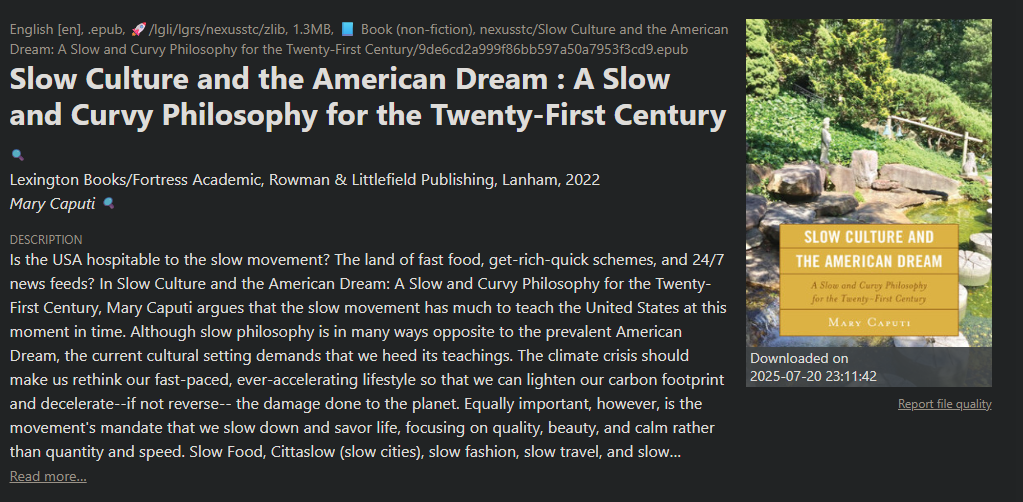
Recommended by Danica Swanson https://farcaster.xyz/danicaswanson